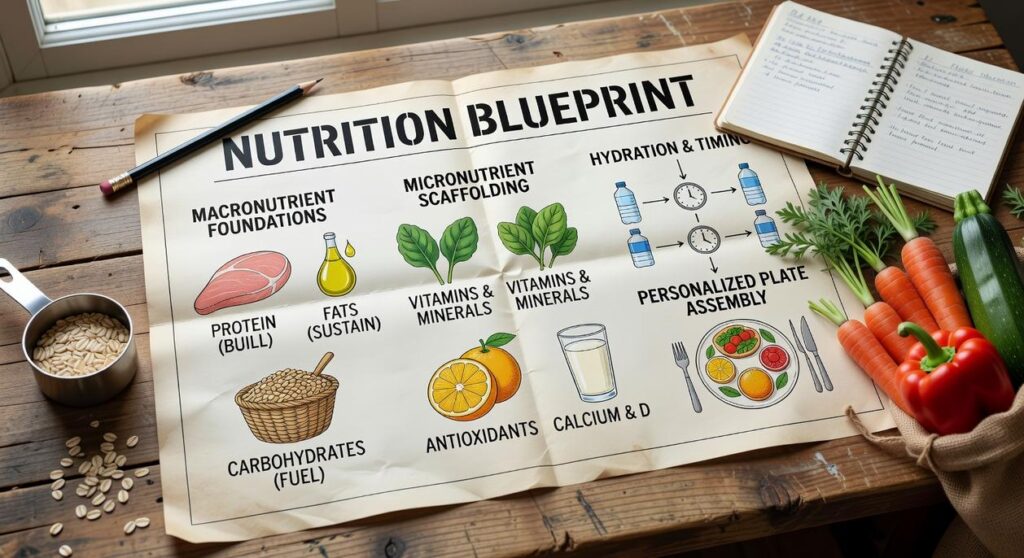

If you’ve been searching for a clear, science-backed way to fuel your body without confusion, this macronutrient balance guide is designed for you. Many people struggle to understand how much protein, carbohydrates, and fats they actually need—leading to stalled progress, low energy, or inconsistent results in the gym. This article breaks down the role of each macronutrient, explains how to adjust ratios based on your goals, and shows you how to build meals that support strength, performance, and recovery.
We’ve grounded this guide in established nutritional research and practical fitness application, drawing from evidence-based dietary frameworks and performance-focused conditioning principles. Instead of generic advice, you’ll find actionable steps you can apply immediately—whether your goal is fat loss, muscle gain, or improved endurance.
By the end, you’ll understand how to align your daily intake with your training demands and create a sustainable nutrition strategy that supports long-term health momentum.
Your Blueprint for Macronutrient Mastery
Frustrated with diet plans that promise everything and deliver nothing? This macronutrient balance guide gives you a clear, repeatable system for calculating protein, carbohydrates, and fats based on your body, goals, and activity level. Macronutrients are the nutrients your body needs in large amounts to produce energy and repair tissue. When you balance them correctly, you unlock steadier energy, faster workout recovery, improved strength gains, and sustainable fat loss. No guesswork. No conflicting advice. Just a personalized framework that fuels performance, supports health momentum, and delivers results you can actually measure. With lasting confidence built.
The “Big Three”: Understanding Protein, Carbs, and Fats
Protein: THE BUILDER
Protein provides 4 kcal per gram and supplies amino acids—the building blocks of muscle tissue. It supports muscle repair, immune function, and satiety (that full feeling after meals). Critics argue high protein is overhyped, but research shows adequate intake preserves lean mass during fat loss (Phillips et al., 2016). Think eggs, Greek yogurt, tofu, chicken.
Carbohydrates: THE PRIMARY FUEL
Carbs also deliver 4 kcal per gram and power workouts and brain function. Simple carbs digest quickly (fruit, white bread). Complex carbs digest slower (oats, quinoa), offering steadier energy. Some claim carbs cause weight gain; excess calories do (Hall et al., 2012).
Fats: THE ESSENTIAL OPERATOR
Fats pack 9 kcal per gram and aid hormone production and vitamin absorption (A, D, E, K). Avoiding fat entirely? Bad move. Focus on avocados, nuts, olive oil.
| Macro | kcal/g | Key Role |
|—|—|—|
| Protein | 4 | Repair |
| Carbs | 4 | Energy |
| Fats | 9 | Hormones |
Use a macronutrient balance guide to personalize intake.
Step 1: Determine Your Daily Calorie Needs
Start with your Basal Metabolic Rate (BMR), which is the calories your body burns at rest. The Mifflin-St Jeor formula is widely accepted as accurate (Journal of the Academy of Nutrition and Dietetics, 2005):
Men: (10 × kg) + (6.25 × cm) − (5 × age) + 5
Women: (10 × kg) + (6.25 × cm) − (5 × age) − 161
Next, multiply BMR by an activity factor (1.2 sedentary, 1.55 moderate, 1.75 very active) to get Total Daily Energy Expenditure (TDEE).
Example: A 70kg, 30-year-old moderately active male at 175cm:
BMR ≈ 1,648 calories.
TDEE ≈ 1,648 × 1.55 = 2,554 calories.
Step 2: Set Your Protein Intake
For muscle gain, aim for 1.6–2.2g per kg (International Society of Sports Nutrition, 2017).
70kg × 2g = 140g protein.
Protein has 4 calories per gram.
140g × 4 = 560 calories from protein.
(Yes, this is why chicken breast is basically gym folklore.)
Step 3: Set Your Fat Intake
Allocate 20–30% of total calories to fat (Dietary Guidelines for Americans, 2020).
At 25% of 2,554 calories = 638 calories.
Fat has 9 calories per gram.
638 ÷ 9 ≈ 71g fat.
- Pro tip: Don’t slash fats too low; hormones rely on them.
Step 4: Allocate Remaining Calories to Carbs
Subtract protein and fat calories:
2,554 − (560 + 638) = 1,356 calories for carbs.
Carbs have 4 calories per gram.
1,356 ÷ 4 = 339g carbs.
Use this macronutrient balance guide as a baseline. Speculation: As wearable tech improves, macro targets may soon auto-adjust daily based on recovery and sleep data (think less guesswork, more precision).
Fine-Tuning Macros for Your Specific Fitness Goal
Dialing in your macros isn’t about perfection—it’s about alignment. Your calories and macronutrients (protein, carbs, and fats) should match your goal.
For Fat Loss
A caloric deficit means eating about 300–500 calories below your Total Daily Energy Expenditure (TDEE)—the number of calories your body burns daily. This encourages fat loss while minimizing muscle loss.
- Keep protein high (0.7–1g per pound of bodyweight) to preserve lean mass.
- Reduce carbs and/or fats gradually to create the deficit.
- Monitor progress every 2–3 weeks and adjust as needed.
Some argue carbs should be slashed entirely. In reality, balanced reductions are more sustainable (and far less miserable).
For Muscle Gain (Lean Bulking)
A modest surplus of 250–500 calories above TDEE supports muscle protein synthesis—the process of building new muscle tissue.
- Prioritize adequate protein.
- Increase carbs to fuel strength conditioning sessions.
- Keep fats moderate for hormone health.
For Performance & Maintenance
Eating at TDEE maintains weight while optimizing energy. Adjust carb intake around workouts—often called nutrient timing—to improve recovery and output.
If consistency is your challenge, start with this macronutrient balance guide and simplify with meal prepping for the week a step by step guide.
Practical Strategies for Effortless Macro Tracking

Tracking macros does not have to feel like a second job. First, use the right tools. A digital food scale removes guesswork (eyeballing peanut butter is a rookie mistake), and apps like MyFitnessPal or Cronometer simplify logging by storing frequent meals and scanning barcodes. Research shows self-monitoring significantly improves nutrition adherence (National Weight Control Registry), so accuracy matters.
Next, apply the 80/20 rule of nutrition. Aim for 80% of calories from whole, nutrient-dense foods—lean proteins, fruits, vegetables, whole grains—and keep 20% flexible. This approach, often called flexible dieting, supports consistency without feeling restrictive. After all, a slice of pizza can fit into a plan; an all-or-nothing mindset usually does not.
To make weekdays easier, meal prep strategically. Batch cook protein sources like chicken or tofu, pre-portion carbs such as rice or potatoes, and keep healthy fats—olive oil, nuts, avocado—readily available. When components are ready, assembling balanced meals becomes simple.
Finally, treat numbers as a starting point. Use a macronutrient balance guide, then adjust based on energy, workout performance, and recovery. If lifts stall or fatigue lingers, tweak intake. Your body gives feedback—listen to it.
Building Your Sustainable Nutrition Plan
The frustration of one-size-fits-all diets ends here. GENERIC PLANS ignore your metabolism, activity level, and recovery needs. A personalized system works because it’s built on measurable inputs: calorie targets, protein ranges (typically 0.7–1g per pound of bodyweight, per ISSN), carb timing, and fat minimums for hormone health.
Use this macronutrient balance guide to:
- Calculate maintenance calories
- Adjust for fat loss or muscle gain
- Track intake consistently
This structured approach turns guesswork into DATA-DRIVEN ACTION. Start today. Run your numbers. Dial in portions. When you fuel with intention, results stop feeling random—and start becoming predictable.
Build Sustainable Strength Starting Today
You came here to understand how to build real health momentum through smarter training, better nutrition, and intentional recovery. Now you have a clear path forward.
The biggest frustration isn’t lack of effort — it’s putting in the work and not seeing results. Inconsistent nutrition, poor recovery, and unstructured workouts stall progress and drain motivation. That stops today.
Apply what you’ve learned. Dial in your workouts. Prioritize recovery like it matters. Follow a structured macronutrient balance guide so your body has the fuel it needs to build strength, burn fat, and perform at its peak.
Momentum doesn’t come from random effort. It comes from a plan you execute consistently.
If you’re ready to stop guessing and start progressing, take the next step now. Use our proven fitness methods, science-backed nutrition strategies, and recovery frameworks trusted by thousands committed to long-term results. Start your customized plan today and turn your effort into measurable performance gains.

 There is a specific skill involved in explaining something clearly — one that is completely separate from actually knowing the subject. Vorric Eldwain has both. They has spent years working with nutrition and wellness plans in a hands-on capacity, and an equal amount of time figuring out how to translate that experience into writing that people with different backgrounds can actually absorb and use.
Vorric tends to approach complex subjects — Nutrition and Wellness Plans, Workout Recovery Hacks, Health Momentum being good examples — by starting with what the reader already knows, then building outward from there rather than dropping them in the deep end. It sounds like a small thing. In practice it makes a significant difference in whether someone finishes the article or abandons it halfway through. They is also good at knowing when to stop — a surprisingly underrated skill. Some writers bury useful information under so many caveats and qualifications that the point disappears. Vorric knows where the point is and gets there without too many detours.
The practical effect of all this is that people who read Vorric's work tend to come away actually capable of doing something with it. Not just vaguely informed — actually capable. For a writer working in nutrition and wellness plans, that is probably the best possible outcome, and it's the standard Vorric holds they's own work to.
There is a specific skill involved in explaining something clearly — one that is completely separate from actually knowing the subject. Vorric Eldwain has both. They has spent years working with nutrition and wellness plans in a hands-on capacity, and an equal amount of time figuring out how to translate that experience into writing that people with different backgrounds can actually absorb and use.
Vorric tends to approach complex subjects — Nutrition and Wellness Plans, Workout Recovery Hacks, Health Momentum being good examples — by starting with what the reader already knows, then building outward from there rather than dropping them in the deep end. It sounds like a small thing. In practice it makes a significant difference in whether someone finishes the article or abandons it halfway through. They is also good at knowing when to stop — a surprisingly underrated skill. Some writers bury useful information under so many caveats and qualifications that the point disappears. Vorric knows where the point is and gets there without too many detours.
The practical effect of all this is that people who read Vorric's work tend to come away actually capable of doing something with it. Not just vaguely informed — actually capable. For a writer working in nutrition and wellness plans, that is probably the best possible outcome, and it's the standard Vorric holds they's own work to.