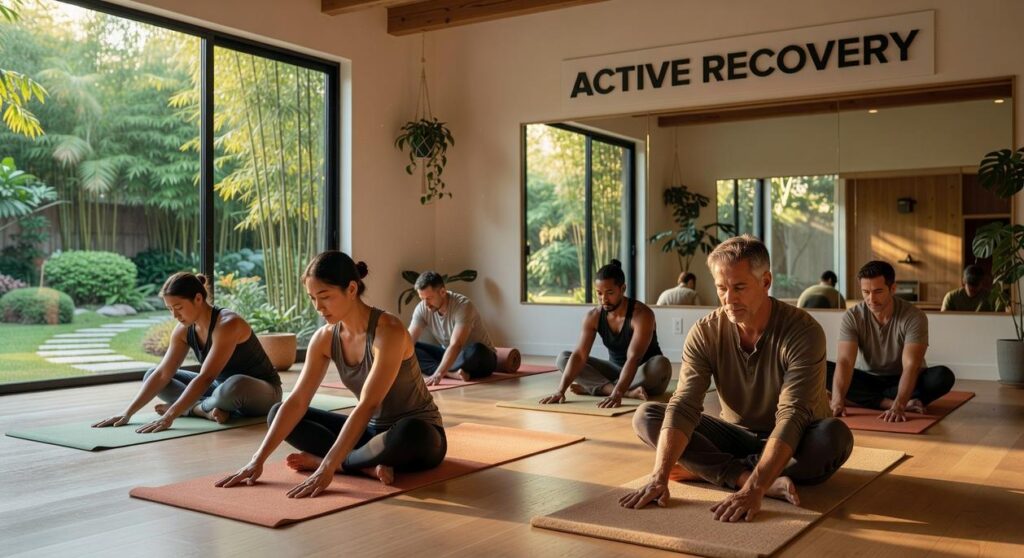

You crushed your workout—but what you do next determines how well your body recovers. Skipping a proper cool-down often leads to lingering soreness, tight muscles, and a greater risk of injury, slowing the progress you worked so hard to build. This guide delivers a clear, step-by-step post workout stretching routine designed to help your muscles recover safely and efficiently. Built on proven strength conditioning and recovery principles, these static stretches target the areas that need it most after training. If you’re looking for simple, effective stretches to enhance flexibility and speed up recovery, you’ll find exactly what you need here.
Why 10 Minutes of Stretching Is Non-Negotiable for Muscle Growth
After intense training, your body remains in a heightened stress state. Static stretching acts as a biological signal, shifting the nervous system from “fight or flight” to “rest and repair.” This transition lowers cortisol levels and supports muscle protein synthesis, the process where fibers rebuild stronger (American Council on Exercise).
At the same time, lengthening warm tissue improves flexibility, meaning your joints move through a fuller range of motion. Better range translates to cleaner squat depth and stronger presses (yes, form matters).
Moreover, gentle holds boost circulation, helping deliver oxygen and nutrients that may ease delayed onset muscle soreness, or DOMS.
Consistent stretching also maintains muscle length, a key factor in preventing strains and tears. A structured post workout stretching routine can include:
- Hamstring and hip flexor holds
- Chest openers
- Calf stretches
Ten focused minutes today safeguards tomorrow’s gains consistently.
The 3 Golden Rules for Safe and Effective Stretching
Rule 1: Breathe Deeply
Inhale as you prepare. Exhale as you move deeper. This simple pattern activates your parasympathetic nervous system—the body’s “rest and digest” mode—helping muscles relax and lengthen more effectively (Harvard Health Publishing). The benefit? Greater flexibility with less resistance (and fewer grimace-worthy moments).
Rule 2: Hold — Don’t Bounce
Static stretching—holding for 20–30 seconds—allows muscle fibers to adapt safely. Ballistic stretching (bouncing) can trigger the stretch reflex, a protective muscle contraction that increases injury risk, especially after exercise (American College of Sports Medicine). Some argue bouncing boosts flexibility faster. Short term, maybe. Long term, controlled holds win for safety and steady progress.
Rule 3: Find Tension, Not Pain
A productive stretch feels like mild, steady tension—not sharp, stabbing, or electrical pain. Discomfort means growth; pain signals damage. During a post workout stretching routine, this distinction protects recovery, improves mobility, and keeps you training consistently.
Guided Lower Body Reset: Hamstrings, Quads, and Glutes

A smart post workout stretching routine helps reduce stiffness, improve mobility, and support long-term strength gains (research shows regular flexibility work can improve range of motion and performance; see ACSM guidelines).
Standing Hamstring Stretch
- Stand with feet hip-width apart.
- Extend one leg forward, heel on the ground, toes pointing up.
- Keep your spine neutral and hinge at the hips (not the waist).
- Place hands on your hips or lightly on your thigh for support.
- Stop when you feel tension in the back of the thigh.
- Hold for 20–30 seconds, then switch sides.
Pro tip: Think “chest forward” instead of “reach down.” It keeps your back flat and the stretch targeted.
Standing Quad Stretch
- Stand tall and shift weight onto one leg.
- Bend the opposite knee and grab your ankle behind you.
- Keep knees close together and gently press hips forward.
- Engage your core to stay balanced (use a wall if needed).
- Hold 20–30 seconds per side.
If balance is tricky, that’s normal—tight quads often tag along with desk jobs.
Figure-Four Stretch (Glutes & Piriformis)
Lying version:
- Lie on your back, knees bent.
- Cross one ankle over the opposite thigh.
- Pull the bottom leg toward your chest.
- Hold 30 seconds, then switch.
Standing version:
- Cross ankle over opposite knee.
- Sit back like a mini squat.
- Keep chest lifted and hips square.
For deeper recovery guidance, review active recovery vs complete rest what your body really needs to balance mobility with rest days.
Release Upper Body Tension: Chest, Shoulders, and Back
After heavy pressing or long hours at a desk, the chest, shoulders, and back can feel locked up. Let’s break down a few simple moves that restore balance and make your post workout stretching routine far more effective.
Doorway Chest Stretch
Stand in a doorway and place your forearms on each side of the frame, elbows at about 90 degrees. Step one foot forward and gently shift your weight until you feel a stretch across the pectoral muscles (the large chest muscles used in pushing movements). Keep your ribs down and core lightly engaged so you don’t arch your lower back. Think “open chest,” not “lean and crank.”
Cross-Body Shoulder Stretch
Bring one arm straight across your body at shoulder height. Use the opposite hand to support the arm just above the elbow. Stretch the deltoid (shoulder muscle) without shrugging your shoulder toward your ear. If your neck tightens, reset and relax. Pro tip: imagine tucking your shoulder blade into your back pocket.
Cat-Cow Stretch
Move onto hands and knees. Inhale as you drop your belly and lift your chest (Cow). Exhale as you round your spine and tuck your chin (Cat). This dynamic spinal mobilization improves flexibility and may reduce back discomfort (Harvard Health Publishing). Slow, controlled breaths make all the difference.
Child’s Pose is, in my opinion, the most underrated finale to any post workout stretching routine. Kneel, bring big toes together, sink hips to heels, and fold forward with arms extended. Feel the gentle stretch along your spine, hips, and ankles as your forehead rests down. It’s like hitting a reset button for nervous system.
- Slow your breathing.
- Let your shoulders melt.
For Lying Spinal Twist, lie on your back, hug one knee in, guide it across body, and extend opposite arm. Keep shoulders grounded. This wrings out lower-back and core tension (the good kind). Switch sides slowly
Make This Cool-Down Your New Fitness Habit
You came here looking for a simple way to recover better after every workout—and now you have a complete, guided post workout stretching routine you can rely on. By taking just a few intentional minutes to cool down, you reduce the muscle soreness and stiffness that slow your progress and drain your motivation.
This routine works because it targets the exact muscle groups you just trained, using safe, proven static stretches that support faster recovery and better performance.
Don’t let tight muscles hold back your results. Bookmark this guide now and make it non-negotiable. Start today—and feel the difference in your very next workout.

 There is a specific skill involved in explaining something clearly — one that is completely separate from actually knowing the subject. Vorric Eldwain has both. They has spent years working with nutrition and wellness plans in a hands-on capacity, and an equal amount of time figuring out how to translate that experience into writing that people with different backgrounds can actually absorb and use.
Vorric tends to approach complex subjects — Nutrition and Wellness Plans, Workout Recovery Hacks, Health Momentum being good examples — by starting with what the reader already knows, then building outward from there rather than dropping them in the deep end. It sounds like a small thing. In practice it makes a significant difference in whether someone finishes the article or abandons it halfway through. They is also good at knowing when to stop — a surprisingly underrated skill. Some writers bury useful information under so many caveats and qualifications that the point disappears. Vorric knows where the point is and gets there without too many detours.
The practical effect of all this is that people who read Vorric's work tend to come away actually capable of doing something with it. Not just vaguely informed — actually capable. For a writer working in nutrition and wellness plans, that is probably the best possible outcome, and it's the standard Vorric holds they's own work to.
There is a specific skill involved in explaining something clearly — one that is completely separate from actually knowing the subject. Vorric Eldwain has both. They has spent years working with nutrition and wellness plans in a hands-on capacity, and an equal amount of time figuring out how to translate that experience into writing that people with different backgrounds can actually absorb and use.
Vorric tends to approach complex subjects — Nutrition and Wellness Plans, Workout Recovery Hacks, Health Momentum being good examples — by starting with what the reader already knows, then building outward from there rather than dropping them in the deep end. It sounds like a small thing. In practice it makes a significant difference in whether someone finishes the article or abandons it halfway through. They is also good at knowing when to stop — a surprisingly underrated skill. Some writers bury useful information under so many caveats and qualifications that the point disappears. Vorric knows where the point is and gets there without too many detours.
The practical effect of all this is that people who read Vorric's work tend to come away actually capable of doing something with it. Not just vaguely informed — actually capable. For a writer working in nutrition and wellness plans, that is probably the best possible outcome, and it's the standard Vorric holds they's own work to.